
Featured News

Alberta and Canada outline path for west coast pipeline and clearer project reviews
Alberta and Canada have agreed on a plan that could lead to construction of a new Indigenous co‑owned west coast oil pipeline as early as 2027. For CLRA members, this signals more predictable timelines, fewer overlapping reviews and the potential for steady construction demand across pipeline, electricity and carbon capture projects. Together, these factors provide the kind of certainty needed to plan, staff and finance major construction projects across these sectors. A Possible Pipeline The new Alberta-Canada energy MOU requires Alberta to submit a comprehensive proposal for a bitumen pipeline, which would move more than one million barrels of oil per day to Asian markets, to the federal Major Projects Office by July 1, 2026. In turn, it commits the federal government to review Alberta’s pipeline submission through the Major Projects Office and decide by October 1, 2026 whether it will be a project of national interest. If approved, design and construction of the proposed pipeline could begin by September 1, 2027. Significant conditions remain. B.C. has not consented to a northern route and Indigenous consultation is ongoing. Both governments say they will work with First Nations and Métis communities early and consistently, and that the project could support long‑term

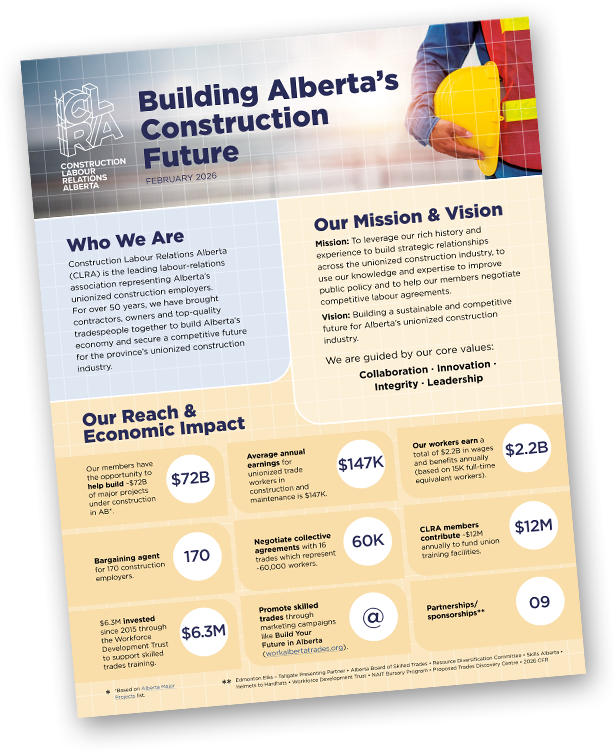
Building Alberta’s Construction Future
Building Alberta's Workforce Together
CLRA Teaming Up with the Edmonton Elks
Here’s why you should consider the trades:
WorkAlbertaTrades.org/Education-Tools-for-Trades
Learn about diversity in the trades:
WorkAlbertaTrades.org/Todays-New-Workforce
News

Alberta’s 2026–27 Budget: Capital Commitments and the Construction Opportunity Ahead
Last week’s provincial budget delivered a major commitment to Alberta’s construction sector. With the theme of Focused on What Matters, Budget 2026’s three-year Capital Plan is forecast at $28.3 billion, which is a $2.2 billion increase from Budget 2025. For 2026-27, capital spending is forecast at $8.7 billion; $48 million more than estimated in Budget 2025. This historic increase in capital investment is directed at public services infrastructure across the province including schools, hospitals, and critical community facilities to better meet Alberta’s growing population demands. For construction employers, this budget represents a significant and sustained opportunity. The scale of capital spending being deployed means increased project flow, stronger workforce demand, and a growing need for the kind of skilled and experienced contractors that CLRA represents. We continue to work with the government to ensure our members are actively considered for these projects. However, the increased spending does create fiscal challenges for the province. Last week’s provincial budget highlighted the challenges of declining resource revenues and rising cost pressures, with total spending rising to $83.9 billion, up from $4.5 billion last year, and a $9.4 billion deficit is projected for 2026-27. Detailed information on the budget can be found on the

Alberta’s Population Boom: What It Means for Construction
New population projections from Statistics Canada and analysis from ATB Financial show Alberta is set to lead the country in growth over the next 25 years. For the construction industry, more people means more demand for housing, infrastructure and commercial development. The Numbers Alberta’s population will grow by between 1.4 and 3.1 million people over the next 25 years depending on which growth scenario unfolds. Under medium projected growth, the province’s population grows from about 5 million residents today to over 7.3 million by 2050, a 46% increase – the highest of any province. The national population will grow by a more modest 17% over the same period. Alberta’s population growth is at least double the national average in all scenarios. Annual growth in Alberta will average 1.5% over the projection period compared to 0.6% nationally. International migration will account for just over half of Alberta’s population growth to 2050, with interprovincial migration accounting for 29.4% and natural increase accounting for 18.5%. Alberta is one of only two provinces projected to see ongoing gains from interprovincial migration, meaning people are choosing to move here from other parts of Canada. What This Means for Construction A population increase of 2.3 million

NAIT’s New Skilled Trades Council Brings Additional Expertise to Strengthening Trades Training
NAIT has formed a Skilled Trades Council to guide planning for its Advanced Skills Centre (ASC), a training facility that will add capacity for 5,500 additional trades learners every year at its Edmonton campus. Who is on the Council The Skilled Trades Council includes Naseem Bashir, Co‑Chair and Executive Chair of Originus Ltd., Doreen Cole, Co‑Chair and Alberta energy executive, Carla Madra, CEO of Women Building Futures, and Jason Portas, Vice President at PCL Construction. Together they bring experience leading major energy operations, delivering complex infrastructure projects, advancing workforce development and driving innovation across engineering and technology. Their role is to ensure the ASC reflects the realities of modern worksites and the future of the industries it is built to serve. CLRA is grateful for the leadership and time these council members are contributing as Alberta works to strengthen the province’s skilled trades training capacity. What Is the Advanced Skills Centre The ASC will bring together 29 trades and technology programs under one roof, enabling NAIT to train more than 15,000 students annually across industries. The facility is in its final year of planning and design and is backed by provincial funding. The ASC is a new, long-term investment in
Excerpt: Board Chair's New Year Message to Members
“Over the next several months, much of our association’s focus for that work will be advocacy with the provincial government and with other industry stakeholders. Politics in Alberta have changed dramatically and permanently over the last decade. As a result, we have work to do to raise awareness about CLRA with decision-makers and influencers in government.
“We have important messages to deliver on your behalf about the value of the collective agreements we’ve signed with the skilled trade unions, about the value CLRA offers to government efforts to attract investment and workers to Alberta, about the need for more predictable and stable investments in the construction industry, trades education and workforce retention, about the impact of potential changes to labour legislation, workplace safety regulations and building codes, and about the need to attract and recruit more people to our industry from underrepresented groups including women, LGBTQ2S+ and Indigenous people.
“As Chair, my only ask of our members this year is to support these efforts.”